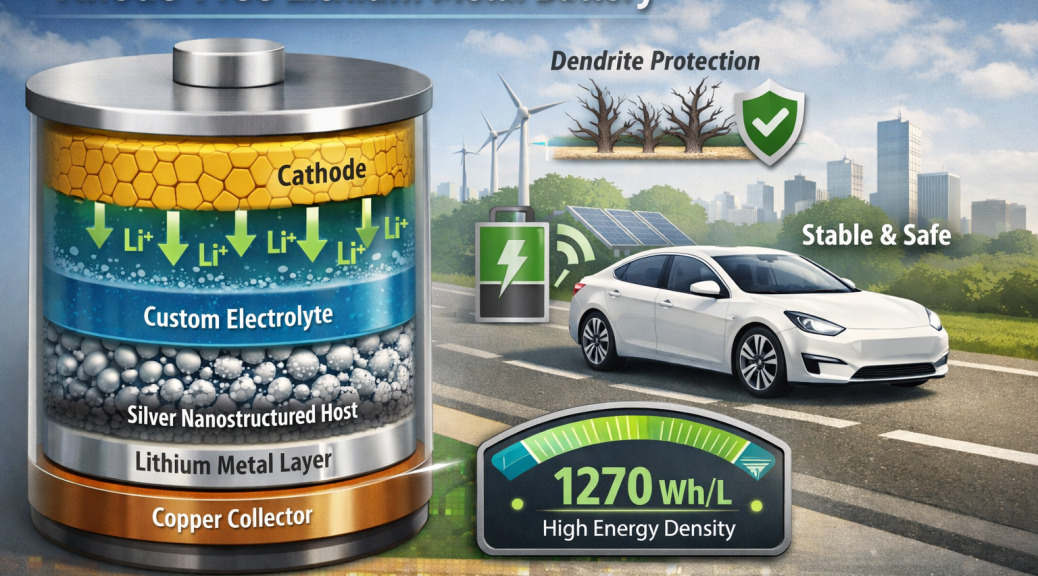
Researchers in South Korea have developed a new anode-free lithium metal battery with a volumetric energy density of up to 1,270 watt-hours per liter—about twice that of today’s mainstream lithium-ion batteries used in electric vehicles. The advance could significantly extend driving range, potentially allowing electric cars to travel nearly twice as far on a single charge. The study was published in the latest issue of Advanced Materials.

Unlike conventional lithium-ion batteries, which rely on a graphite or silicon-based anode, anode-free batteries remove the anode entirely. During charging, lithium ions move directly from the cathode and deposit onto a copper current collector. By eliminating the anode, more internal space is freed for energy storage, similar to fitting more fuel into the same-sized tank.
Despite their promise, anode-free designs face major technical hurdles. Uneven lithium deposition can lead to the formation of dendrites—needle-like structures that may pierce the separator and cause short circuits or safety failures. Repeated charging and discharging can also damage the lithium surface, resulting in rapid capacity loss and a shortened battery lifespan.
To overcome these challenges, scientists from the Korea Advanced Institute of Science and Technology (KAIST), POSTECH, and Gyeongsang National University introduced a “dual-protection strategy.” The approach combines a reversible host structure with a specially formulated electrolyte.
The reversible host consists of a polymer framework embedded with evenly distributed silver nanoparticles. This structure guides lithium ions to deposit uniformly, effectively providing designated “parking spots” that prevent chaotic buildup. Meanwhile, the customized electrolyte forms a dense and stable protective layer on the lithium surface. This layer suppresses dendrite growth while allowing smooth ion transport, acting like a smart protective film that shields the interface without blocking performance.
Performance tests showed clear benefits from this combined design. At a high areal capacity of 4.6 mAh/cm² and a current density of 2.3 mA/cm², the battery retained 81.9% of its initial capacity after 100 charge–discharge cycles. It also achieved an average coulombic efficiency of 99.6%, supporting the reported energy density of 1,270 Wh/L.
Importantly, the results were not limited to small laboratory cells. The technology also demonstrated stable performance in pouch-type batteries that more closely resemble commercial products. Even with reduced electrolyte volume and under low-pressure conditions, the cells operated reliably, highlighting the potential for lighter weight, smaller size, and lower manufacturing costs.
By addressing both efficiency and lifespan, this research tackles two of the most critical barriers facing anode-free lithium metal batteries. The findings mark a meaningful step toward practical, high-energy batteries for future electric vehicles and other energy storage applications.